

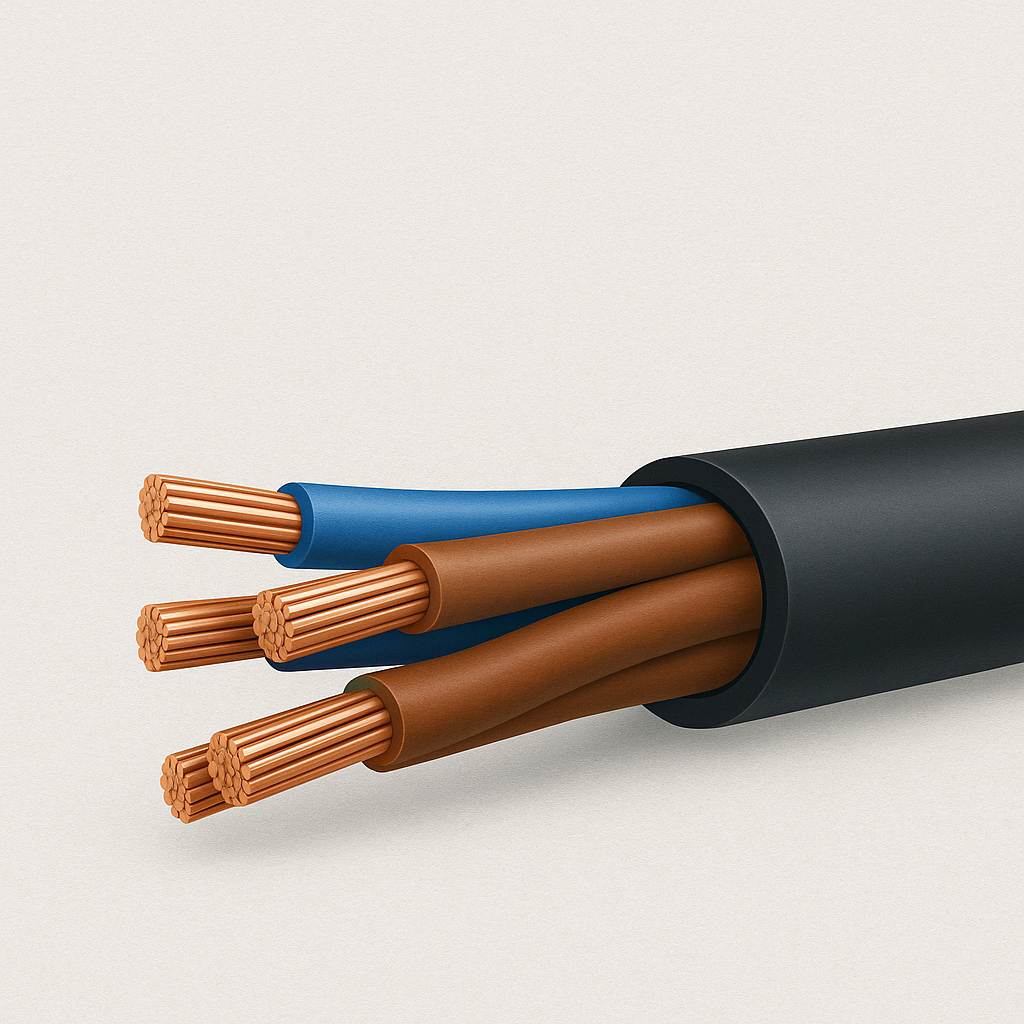
Most electrical fires don't start because someone did something obviously wrong. They start because a wire that was already carrying more load than it should have, or sitting in a wall cavity for fifteen years, finally gave out at the worst possible moment. That's really the whole reason FR wire exists as a category, and it's why Ambica Cables has spent years building out our FR Wires range under the Radilite brand rather than treating it as a minor variant of our standard PVC insulated wire. An FR wire isn't marketed as a premium add-on — it's insulation that's been formulated specifically to slow a fire down at the exact point where ordinary PVC would help it spread.
Short circuits, overloaded circuits and ageing wiring are the usual suspects behind electrical fires, and once a standard PVC-insulated wire catches, it can carry flame along its own length almost like a wick running through a wall or conduit. FR-grade PVC is built to interrupt exactly that. It's formulated to resist ignition in the first place and, if it does catch, to self-extinguish once the original heat source is gone rather than keep burning on its own. That distinction — resisting versus merely surviving — is the entire point of specifying FR wire in a building that has people in it.
There's a fair amount of loose labelling in this market, so it's worth being specific. FR means flame retardant, and a genuine FR wire depends on the PVC compound itself — the additive package and mix ratio used during insulation extrusion — not a sticker applied after the fact. A properly formulated FR compound has a higher oxygen and temperature index than standard PVC, meaning it needs more heat and more oxygen before it will sustain a flame at all. That's a chemistry and process outcome, and it's exactly what building codes and fire-safety consultants are checking for when they specify FR or FRLS cable on a project.
Fire safety aside, a wire still has to do its actual job of carrying current efficiently, and that comes down to conductor quality more than anything else. We use high-conductivity electrolytic grade copper across our FR range, which keeps resistance low and current-carrying capacity high without unnecessary voltage drop over longer circuit runs. Lower resistance copper also runs cooler under load, which matters more in an FR context than a normal one — less heat generated at the conductor means less stress placed on the insulation surrounding it, which supports the whole point of using FR-grade PVC in the first place. Better copper, in other words, isn't a separate selling point from fire safety; the two work together.
Our FR wires use HRFR-grade PVC — Heat Resistant Flame Retardant — developed from an indigenous compound formulation we've refined over the years to balance heat resistance, tensile strength and flame performance. On our double-insulated constructions, a primary layer of virgin-grade PVC is coated with a secondary, skin-coloured FR-grade layer, giving the wire a second line of protection rather than relying on a single insulation pass. That combination gives real margin: a working temperature index around 120°C, strong insulation resistance and volume resistivity to stop current leakage, and enough tensile strength to handle the physical stress of being pulled through conduit or bent around junction boxes during installation without the insulation thinning or cracking at the bend points.
FR wiring has moved well past being an industrial-only specification. It now shows up as a baseline requirement across a lot of ordinary construction — residential apartment towers where fire spread between units is a genuine concern, commercial offices and retail spaces working to updated fire codes, hospitals and schools where evacuation time is everything, hotels, government buildings, and industrial plants where flammable material is stored nearby. If you're an electrician or contractor working on any multi-unit residential or commercial project in most Indian cities today, FR-grade wiring is very likely part of what gets the building its fire clearance, not an optional upgrade a client can skip to save money. The same projects usually also need control panel and equipment wiring, which is where our multicore flexible cable range typically comes in, and if the site includes a borewell or water pumping system, our submersible pump cable covers that end of the installation.
There's a real cost difference between a properly formulated HRFR compound and a standard PVC mix with just enough flame-retardant additive stirred in to claim the label. We've deliberately stayed on the more expensive side of that line. A wire that's sold as FR but doesn't actually perform under real fire conditions isn't a minor quality shortfall — it's a safety failure at precisely the moment it was supposed to matter. We'd rather lose an order to a price-only buyer than sell wire that can't back up its own name on the box. That's also why every batch we produce goes through more than 22 lab tests as per IS:694 before it leaves the factory, covering conductor resistance, insulation resistance, tensile strength and dimensional accuracy — not a spot check every few runs, but a consistent standard applied to each batch.
Put together, our FR wires give you 99.97% pure electrolytic grade copper for efficient, low-loss conductivity; HRFR grade PVC insulation rated for genuine fire resistance at higher temperatures; a documented 22-plus test regime under IS:694 on every batch; and a working temperature index of roughly 120°C that gives real headroom above normal operating conditions. None of this shows up as a dramatic difference on installation day — a good FR wire and a mediocre one look almost identical coming off the reel. The difference only becomes visible either in a lab test or, worse, in an actual fire, which is exactly why it's worth sourcing from a manufacturer that tests every batch rather than taking the claim at face value.
FR wire is rarely the only thing a project needs. If you're wiring a building end to end, our general-purpose PVC Insulated Wires and Cables cover the non-fire-rated circuits, our Multicore Flexible Cable range handles control panel and equipment wiring, and if the project includes a borewell or water pumping system, our Submersible Electrical Wire, Submersible Pump Cable and Submersible Flat Cable ranges are built to the same underlying quality standard for underground and underwater duty.
Whether you're wiring a single apartment or specifying FR cable across a full commercial development, our team can help match the right size and construction to your load and fire-code requirement. Get in touch through our contact page, or reach us directly for a quote on your next project.
